
Our paper, “Perceptual and cognitive foundations of information visualization,” was published in the Annual Review of Vision Science.
AUthors: Karen b. Schloss
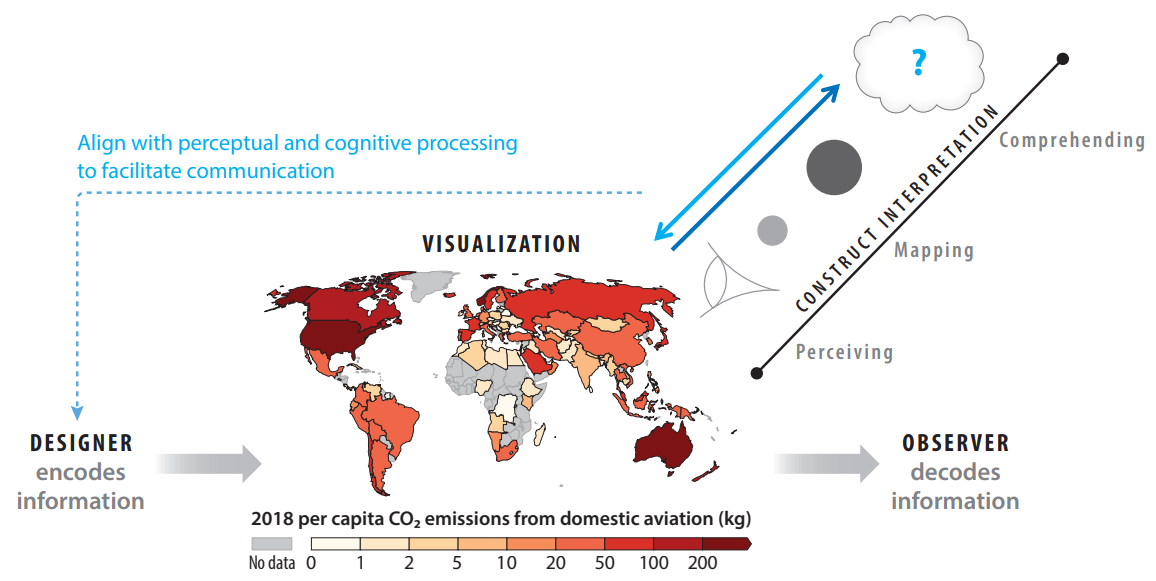 Information visualization is central to how humans communicate. Designers produce visualizations to represent information about the world, and observers construct interpretations based on the visual input as well as their heuristics, biases, prior knowledge, and beliefs. Several layers of processing go into the design and interpretation of visualizations. This review focuses on processes that observers use for interpretation: perceiving visual features and their interrelations, mapping those visual features onto the concepts they represent, and comprehending information about the world based on observations from visualizations. Observers are more effective at interpreting visualizations when the design is well-aligned with the way their perceptual and cognitive systems naturally construct interpretations. By understanding how these systems work, it is possible to design visualizations that play to their strengths and thereby facilitate visual communication.
Reference: Schloss, K. B. (2025). Perceptual and cognitive foundations of information visualization. Annual Review of Vision Science, 11, 1, 303-330. PDF