Welcome to the Schloss Visual Reasoning Lab! We are part of the Department of Psychology and Wisconsin Institute for Discovery, Virtual Environments Group at the University of Wisconsin–Madison. The lab is located on on ancestral Ho-Chunk Land as recognized in the UW-Madison Land Acknowledgment.
Our lab aims to understand how people use visual reasoning for visual communication. We study how people form associations between visual features (e.g., color, shape) and concepts, and how they use those associations to interpret meanings of visual features in information visualizations (e.g., graphs, maps, diagrams, signs). Our lab also investigates how to increase engagement in science through immersive experiences in scientific visualizations using virtual reality. Our work can be translated to making visual communication more effective and efficient.
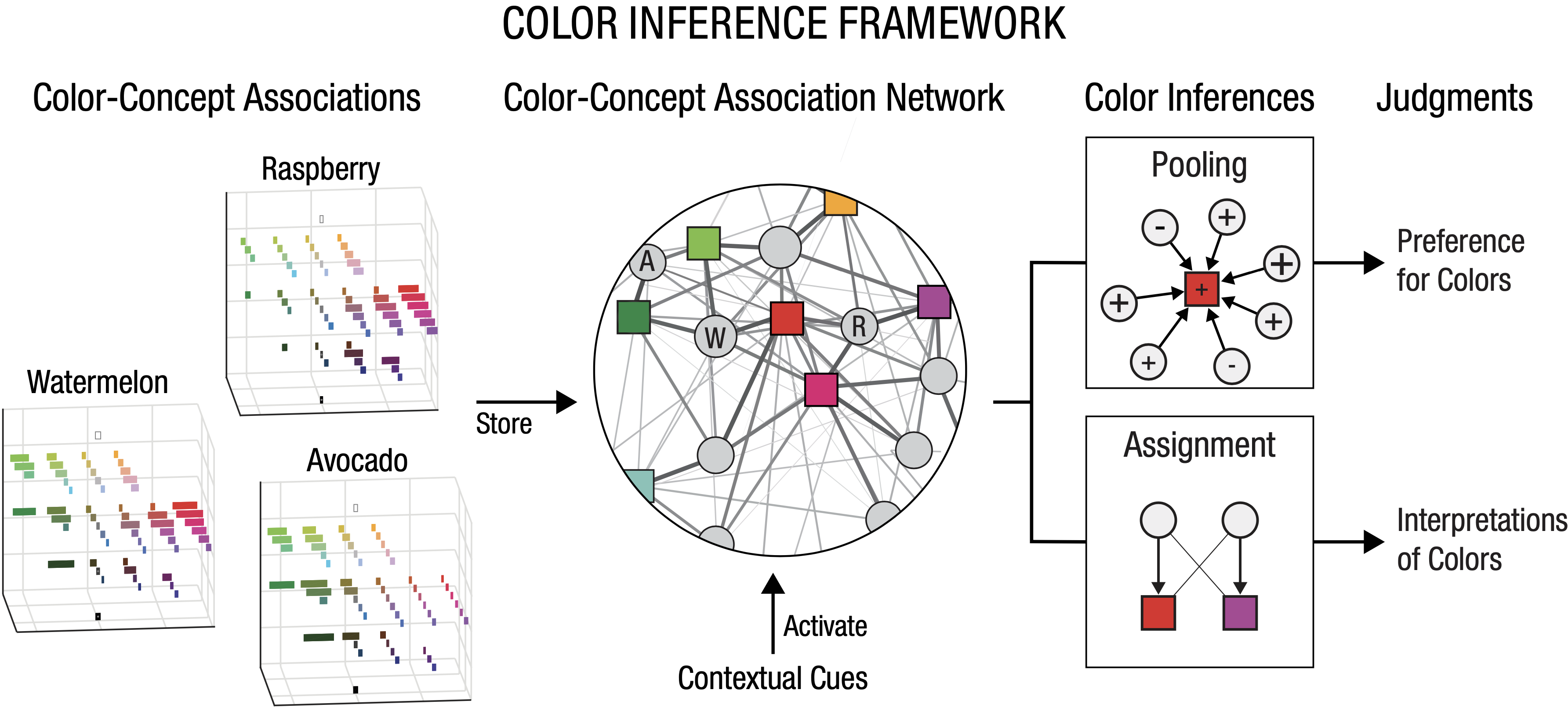
Much of our lab’s research is motivated by the Color Inference Framework, an account of how people use associations between colors and concepts to make judgments about the world. We are currently testing the extensibility and limitations of this framework for visual and tactile texture. The Color Inference Framework has three key premises:
(1) Color-concept associations. People continually form and update associations between colors and concepts as they experience the world.
(2) Color-concept association network. Color–concept associations can be represented in a network, with weights on the edges that represent association strengths. For example, a strong weight might connect the concept banana and a saturated yellow, whereas a weight near zero would connect banana and saturated blue. This network structure helps conceptualize how people form coherent judgments under conflicts that arise from the lack of one-to-one correspondence between colors and concepts in the world. Weights vary across the network depending on the relevance of particular colors and concepts for the judgment at hand. Thus, the network structure can adjust to fit the given perceptual and conceptual context.
(3) Color inferences. People make inferences using the color–concept association network to produce judgments. We focus on two types inference operations that result in two types of judgments: pooling results in judgments about preferences for colors and assigning results in interpretations about the meaning of colors in visual encoding systems of information visualizations.
Our current research focuses on understanding how color-concept associations are formed, and how they are used to interpret information visualizations. Our focus is on color, but our findings should extend to other perceptual features insofar as people have systemic associations between those features and concepts.
For an overview of our research motivated by the Color Inference Framework, please see Schloss (2024), published in Current Directions in Psychological Science.
Lab values

Poster adapted from Dr. Sammy Katta after Dr. Karen Schloss took the pledge committing to continuous allyship for marginalized and underrepresented communities. Poster text reads: In this lab, we believe: science is real (microscope image), love is love (rainbow anatomical heart), Black lives matter (brown raised fist), feminism is for everyone (female symbol), trans rights are human rights (transgender flag), disabilities deserve accessibility (multiple disability symbols), immigrants are welcome (statue of liberty).
Projects
Nothing Found
Nothing Found
Nothing Found
News

Karen Schloss receives 2026-27 Romnes Award
Eighteen faculty have been honored with the H.I. Romnes Fellowships to recognize faculty with exceptional research contributions within their first six years from promotion to a tenured position. The award is named in recognition of the late WARF trustees president H.I. Romnes and comes with $60,000 that may be spent over five years.

Aiyana Manglona earns Sophomore Research Fellowship
Supported by the Provost’s Office and the Hilldale Fund, this fellowship provides undergraduate students with $4,000 to pursue an independent research project under the mentorship of UW–Madison faculty or staff. Her project, One Size Does Not Fit All: Challenging the Use of Overarching Guidelines for Data Visualizations will be mentored by Karen Schloss.


Halle Braun and Zoe Howard presented their undergraduate honors theses!
Halle Braun (left two photos) Zoe Howard (right two photos) did an outstanding job presenting their honors theses at Psychology STaRS (Student Thesis and Research Showcase). Congratulations Halle and Zoe! Halle Braun's thesis title: Affective Color [...]

Congratulations Dr. Kushin Mukherjee on defending his dissertation!
Dr. Kushin Mukherjee defended his dissertation on Cognitive Abstractions for Visual Communication, and now he is off to a postdoc at Stanford University! Congratulations Kushin, you did outstanding work at UW-Madison and we can't wait to [...]