



Aiyana Mangloña awarded a Sophomore Research Fellowship

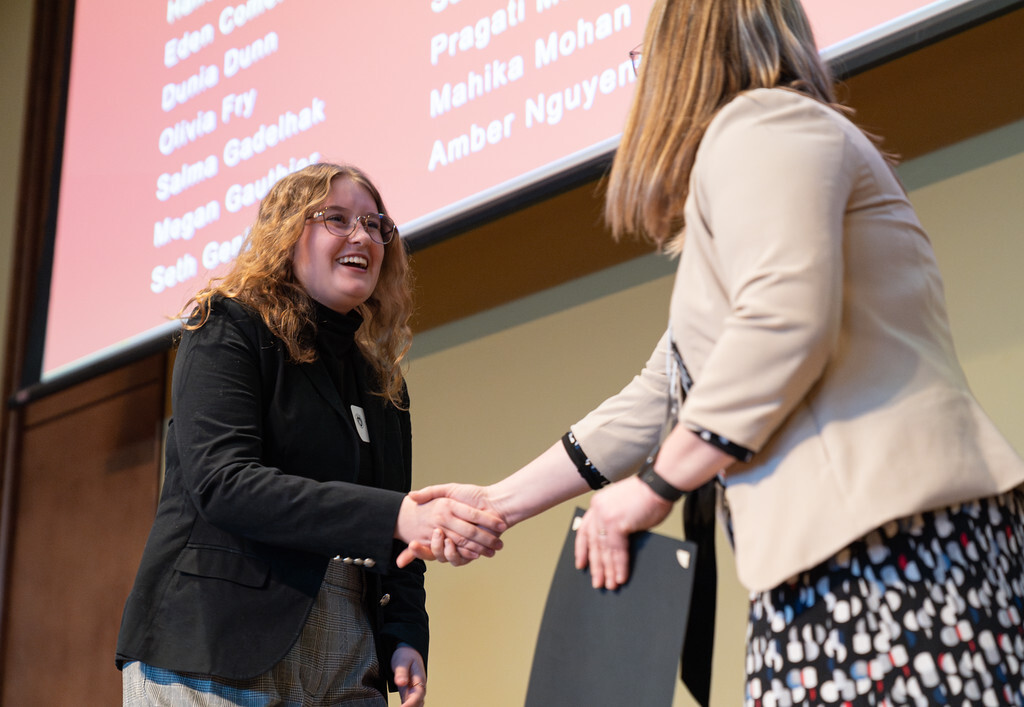
Congratulations to Aiyana Mangloña for receiving a Sophomore Research Fellowship! This fellowship provides research training and support to undergraduate students, and the opportunity to undertake their own research project in collaboration with UW–Madison faculty. This award will support Aiyana’s research project focusing on the overarching use of design guidelines for data visualizations.

PI Karen Schloss received an Excellence in Honors Thesis Advising Award

Congratulations to PI Karen Schloss for receiving an Excellence in Honors Thesis Advising Award! The L&S Honors Program at UW-Madison solicits student nominations of faculty members who have had a special impact as a senior Honors thesis advisor. Honors Program staff members review these nominations and select the strongest nominee in each of L&S’s broad disciplinary areas to receive an Excellence in Honors Thesis Advising Award.

Anna Chinni received a 2025 Walsh Graduate Student Support Initiative (GSSI) Award

Congratulations to Anna Chinni for receiving a 2025 Walsh Graduate Student Support Initiative (GSSI) award, supported by the McPherson Eye Research Institute! This award provides support to UW-Madison graduate students training in a McPherson ERI Member’s laboratory. PI Karen Schloss nominated Anna for this award.

IEEE VIS 2025 Honorable Mention for Best Paper

Our paper “Affective color scales for colormap data visualizations” received Honorable Mention for Best Paper at IEEE VIS 2025!

Abstract: Research on affective visualization design has shown that color is an especially powerful feature for influencing the emotional connotation of visualizations. Associations between colors and emotions are largely driven by lightness (e.g., lighter colors are associated with positive emotions, whereas darker colors are associated with negative emotions). Designing visualizations to have all light or all dark colors to convey particular emotions may work well for visualizations in which colors represent categories and spatial channels encode data values. However, this approach poses a problem for visualizations that use color to represent spatial patterns in data (e.g., colormap data visualizations) because lightness contrast is needed to reveal fine details in spatial structure. In this study, we found it is possible to design colormaps that have strong lightness contrast to support spatial vision while communicating clear affective connotation. We also found that affective connotation depended not only on the color scales used to construct the colormaps, but also the frequency with which colors appeared in the map, as determined by the underlying dataset (data-dependence hypothesis). These results emphasize the importance of data-aware design, which accounts for not only the design features that encode data (e.g., colors, shapes, textures), but also how those design features are instantiated in a visualization, given the properties of the data.

Reference: Braun, H. C., Mukherjee, K., Gorelik, S. R., & Schloss, K. B (2026). Affective color scales for colormap data visualizations. IEEE Transactions on Visualization and Computer Graphics. Honorable mention for Best Paper at IEEE VIS 2025.

PI Karen Schloss received the 2025 Wiley Award for Faculty of the Year

Congratulations to PI Karen Schloss for receiving the Wisconsin Institute of Discovery’s (WID) 2025 Wiley Award for Faculty of the Year! Nominations for the Wiley Award are taken from the WID population at large and the winners chosen by committee. The award recognizes the outstanding community members who represent the core values of WID.

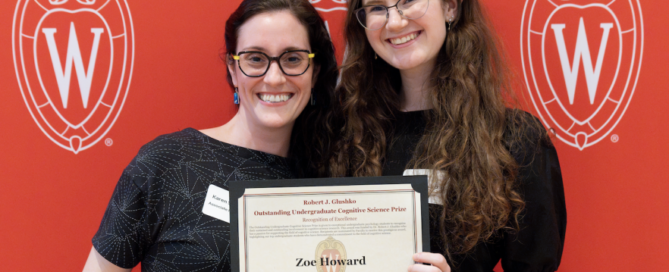
Zoe Howard Awarded a 2025 Glushko Outstanding Undergraduate Cognitive Scientist Prize

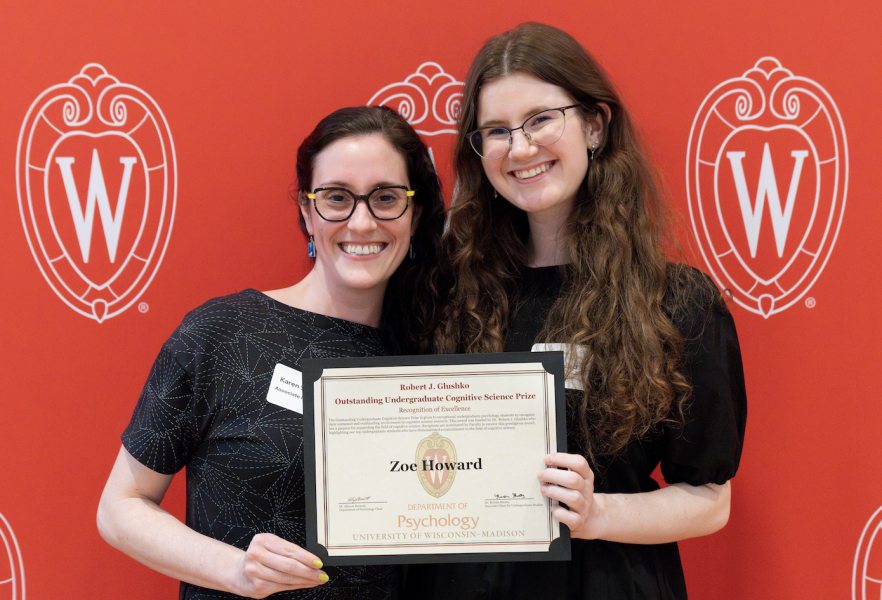
Congratulations to Zoe Howard for receiving a 2025 Glushko Outstanding Undergraduate Cognitive Scientist Prize from the Department of Psychology at UW-Madison!

This prize is awarded annually to a senior Psychology major who has demonstrated a strong combination of academic excellence,  sustained and outstanding involvement in cognitive science research, and engagement in learning about cognitive science at UW and beyond via activities such as classwork, research, independent reading, and/or conference attendance.


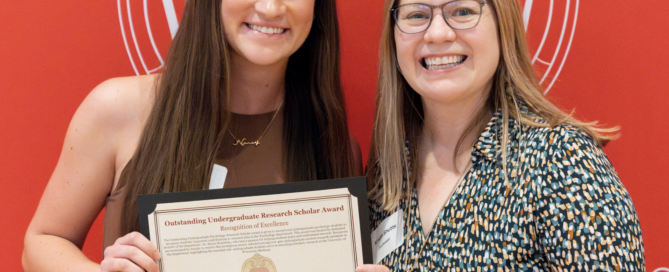
Nancy Davis received a 2025 Outstanding Undergraduate Research Scholar (OURS) Award

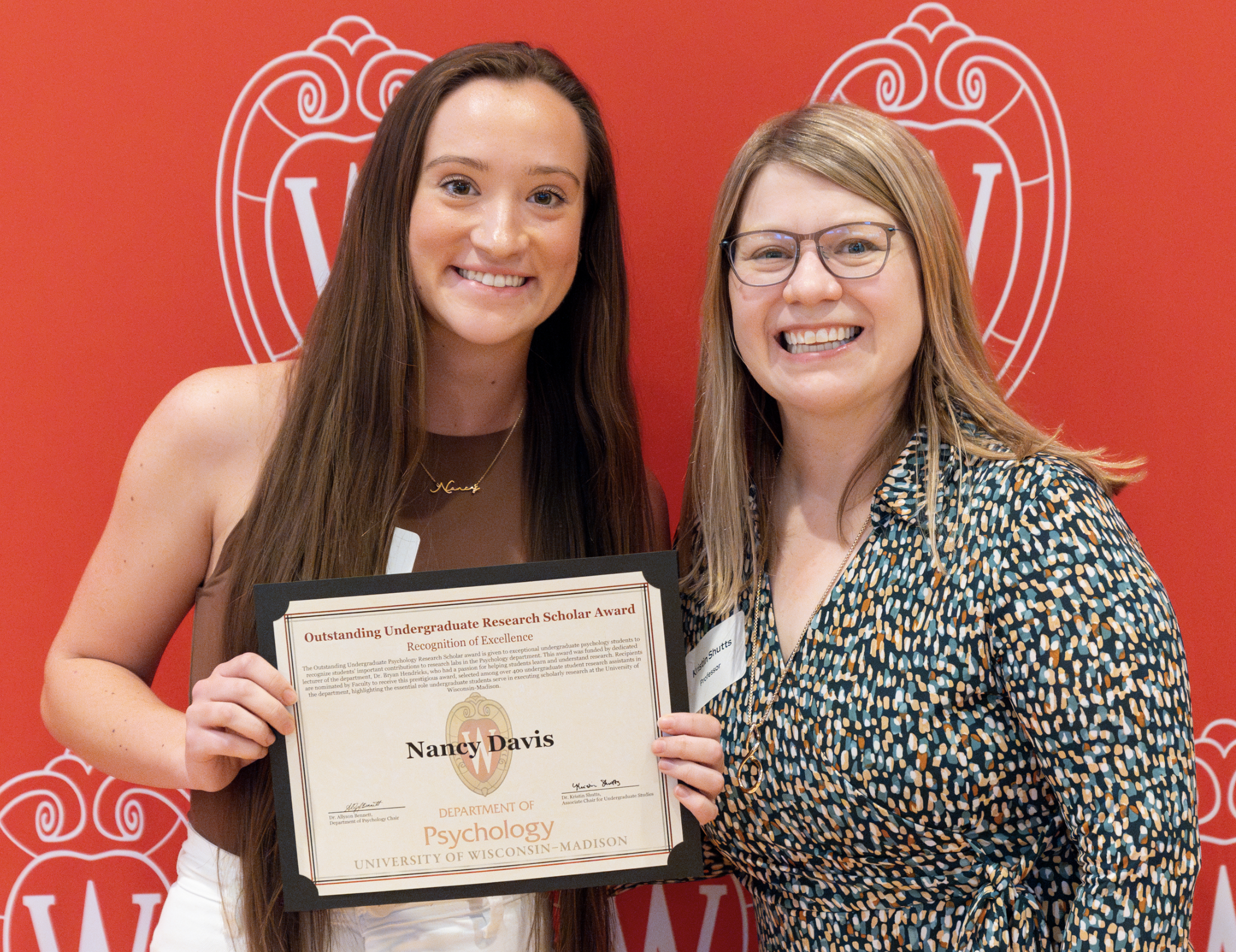
Congratulations to Nancy Davis (left) for receiving an Outstanding Undergraduate Research Scholar (OURS) Award from the UW-Madison Department of Psychology!

This award recognizes outstanding undergraduate Psychology majors for their contribution to research in our department. We thank Nancy for her outstanding work in our lab!

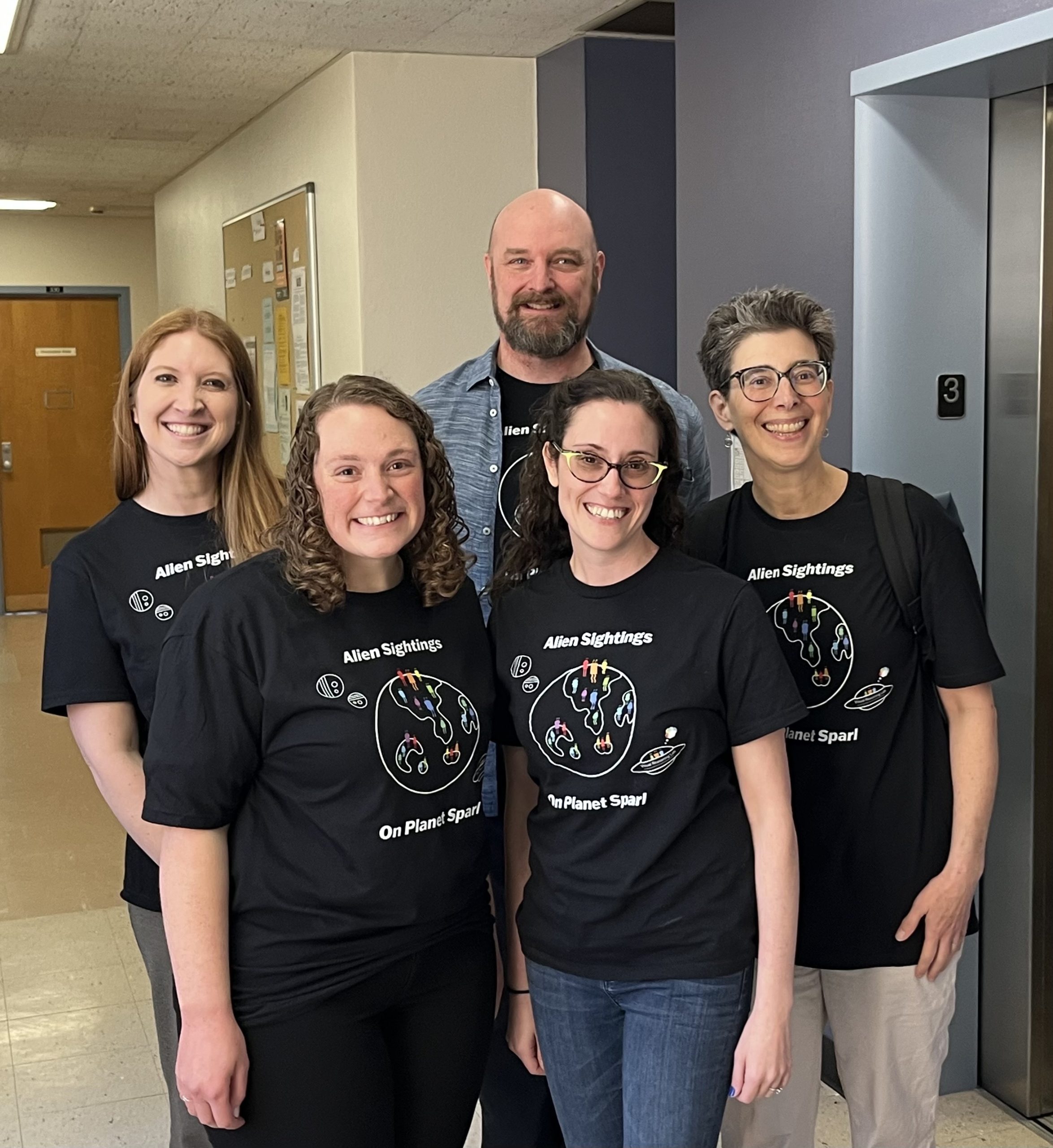
Dr. Melissa Schoenlein defended her dissertation!

Dr. Melissa Schoenlein defended her dissertation on Effects of color category structure on learning and generalization of color-concept associations for novel concepts. Now, Melissa is off to start a faculty position in Psychology at High Point University!

Congratulations Melissa! We are so incredibly proud of you and excited for you to start this next exciting step in your career!

Photo: Melissa Schoenlein and PhD Advisor Karen Schloss (front row); Dissertation Committee Members Haley Vlach, Tim Rogers, Jenny Saffran (back row)


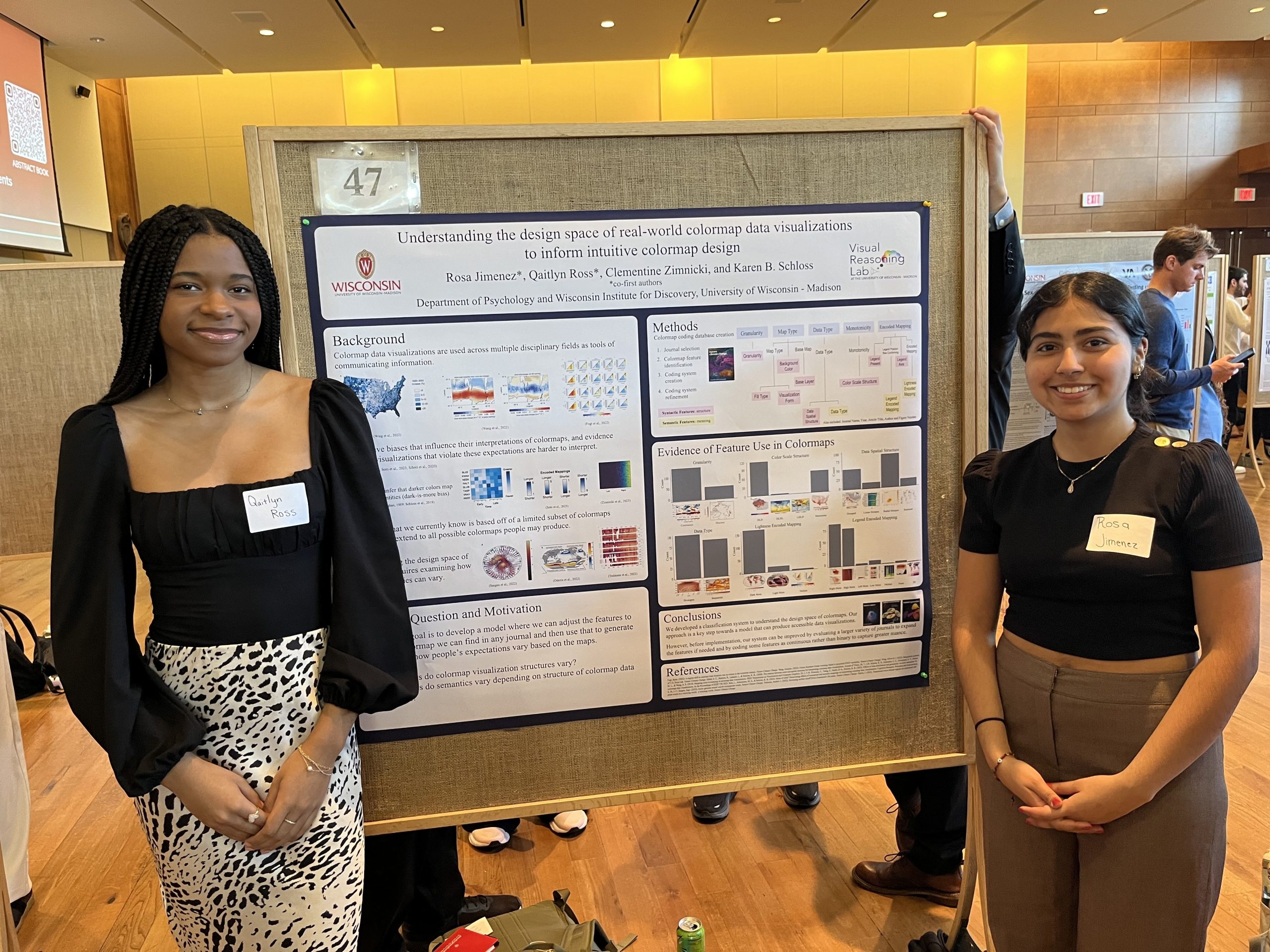
Students presented their research at the 2024 Undergraduate Research Symposium

Students from the Schloss Visual Reasoning Lab presented their work at the 27th annual Undergraduate Symposium! The annual Undergraduate Symposium showcases undergraduate creativity, achievement, research, service-learning, and community-based research from all areas of study at UW–Madison including the humanities, arts, biological sciences, physical sciences, social sciences, and computer data and information sciences.

Left: Qaitlyn Ross and Rosa Jimenez presented their poster on Understanding the Design Space of Real-world Colormap Data Visualizations to Inform Intuitive Colormap Design. Qaitlyn and Rosa conducted this research as part of the Undergraduate Research Scholars program at UW-Madison.

Right: Melina Mueller presented her research on the Effect of Second-Order Conditioning on Category Extrapolation for Learning Novel Color-Concept Associations. Melina conducted this research for her senior honors thesis, supported by the Hilldale Undergraduate/Faculty Research Fellowship sponsored by the McPherson Eye Research Institute.